

Catching Up With Imraan Khan ’12, ’18
 Imraan Khan ’18, MPH, BSN, RN-BC, comes from a family of nurses. His mother was an emergency department nurse for more than 30 years, and he and his twin sister – now a nurse leader – spent a lot of time in hospital environments growing up.
A 2012 graduate of Stony Brook University with a degree in biology, Khan initially pursued other avenues in healthcare, but ultimately transitioned to a career in nursing. In 2017, he enrolled in the School of Nursing’s Accelerated Baccalaureate Program (ABP) and, today, works as a nurse manager at Long Island Jewish Medical Center (LIJ).
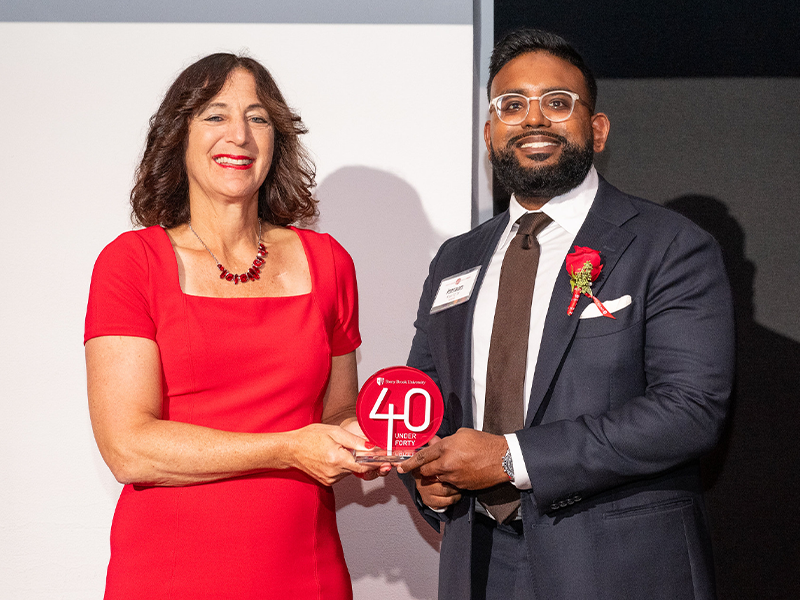
Khan leads an award-winning surgical unit and has co-authored peer-reviewed research spanning nursing, hip and knee arthroplasty, infection prevention, emergency medicine, and radiation oncology. In September, he was included in Stony Brook’s 2026 class of 40 Under Forty alumni honorees, recognizing his impressive accomplishments and identifying him as an SBU alum on the rise.
The School of Nursing recently caught up with Khan following his 40 Under Forty selection.
SON: What inspired you to pursue a career in nursing?
IK: My mother was an emergency department nurse, and my twin sister is also a nurse. Growing up, we saw how nurses cared for people during their most vulnerable moments and how their presence, skill, and compassion could shape a patient’s experience.
Although my path to nursing began with a pivot from another healthcare field, it felt like a natural fit. I wanted a career that combined direct patient care with opportunities for lifelong learning and professional growth. Nursing offered all of that, along with the opportunity to make a meaningful difference in people’s lives.
SON: How did the SBU School of Nursing prepare you for your career?
IK: I graduated from the ABP and had a wonderful experience. Accelerated programs have a reputation for being rigorous and overwhelming, but while the program was challenging, its thoughtful structure and supportive faculty made it feel manageable. The curriculum emphasized knowledge and skills that were directly relevant to caring for patients in real clinical settings.
When I describe the ABP to others, I always say that everything felt intentional and purposeful. I understood how what we were learning would prepare us to become nurses. Just as meaningful was knowing our professors and everyone involved in the program were truly invested in our success. That combination gave me a strong foundation as a new graduate nurse and helped me translate what I had learned into practice.
SON: Talk about your current job. What do you do, what led you to pursue this nursing path, and what is the most fulfilling part about it?
IK: As a nurse manager, I lead a 30-bed unit that cares for patients across several surgical specialties, including otolaryngology, oral and maxillofacial surgery, general surgery, and colorectal surgery. I work closely with nurses and our interdisciplinary partners to address challenges, improve care, and create an environment where both patients and staff feel supported.
Nursing leadership was not a path I had originally planned to pursue. It developed through circumstances and opportunities, and I am grateful for where it has taken me. The role comes with competing priorities and difficult decisions, but I enjoy the daily work of solving problems, supporting others, and helping our team move forward.
One of the most fulfilling parts is watching nurses grow professionally and personally, especially when they step outside their comfort zones to pursue opportunities they might not have considered. Above all, I love hearing a patient or family member tell me that our unit has “good people.” To me, that means they felt the kindness, sincerity, and commitment of the people caring for them. That is the kind of team I am proud to lead.
SON: What led you to pursue research?
IK: Research has been a part of nearly every stage of my academic journey. I have had the opportunity to participate in research across several specialties, including radiation oncology, emergency medicine, public health, and hip and knee arthroplasty. Those experiences strengthened my curiosity and my interest in using evidence to improve care.
In nursing, my research, evidence-based practice, and quality improvement interests are grounded in the challenges we encounter in everyday clinical practice. My work has included efforts to reduce falls, hospital-acquired infections, hypoglycemia, and complications among patients with specialized airway needs, as well as initiatives to improve patients’ rest and overall hospital experience.
SON: What is your fondest memory of your time at the School of Nursing?
IK: What stands out most is the people, especially my classmates. They brought such varied backgrounds and life experiences to the program, and I was always impressed by how those experiences shaped their paths into nursing. Learning alongside them broadened my perspective and helped us become a close, connected class. I have stayed in touch with many of my classmates, and it has been wonderful to see their personal and professional successes.
SON: Which School of Nursing faculty member had the greatest impact on you, and why?
IK: There were so many memorable professors, including Debra Giugliano, Kenneth Faulkner, and Mary Ellen LaSala, whose teaching I still talk about today. Tina Abbate and Annie Rohan also stand out for helping make research and evidence-based practice engaging and meaningful.
Dr. Abbate, in particular, brought an enthusiasm to the subject that stayed with me. Research can be a challenging topic to introduce to nursing students, but she helped me see that my curiosity had a place in nursing and was something worth pursuing. Dr. Rohan encouraged that curiosity and gave me opportunities to participate in projects that went beyond the typical nursing student experience. Her support helped me envision research and evidence-based practice as lasting parts of my nursing career.
SON: What are your future career goals?
IK: I do not have every next step mapped out, but I know I want to continue growing as a nurse leader and supporting the people who depend on me — both our nursing team and our patients. I hope to continue working at the intersection of leadership, mentorship, and research, where I can help nurses develop, turn clinical questions into meaningful improvements, and contribute to better patient care.
SON: What advice would you give current School of Nursing students?
IK: Your time in nursing school will pass more quickly than you expect. Take in as much as you can, stay curious, and recognize that the knowledge and experiences you gain are building the foundation for the nurse you will become.
Keep patients at the center of what you do. Behind every skill, assignment, and clinical experience is the goal of providing safe, compassionate care to someone who needs it. Any of us, or someone we love, could one day be that person.
Finally, do not hesitate to ask for advice, seek support, or express interest in an opportunity. So much of my growth has come from asking someone for guidance or a chance to get involved, and from people who were willing to open a door for me. You do not need to have your entire career planned out, but you do need to be willing to take that first step and ask.
