

Clinical Resources
Precepted clinical placements at the Stony Brook University School of Nursing (SON) provide opportunities for students to gain experience in applying the knowledge they have acquired throughout didactic and experiential coursework.
Clinical settings are diverse and numerous enough to ensure students will meet core curriculum guidelines and program outcomes. In addition to the School of Nursing faculty, these practicum experiences are supervised by clinical preceptors who have demonstrated expertise relative to the student’s educational program. Faculty have academic responsibility for supervising and evaluating students and for overseeing the clinical learning experience.
See below for more information, resources, and a map of our clinical sites.
The Stony Brook University School of Nursing is part of a collaborative with the Nassau-Suffolk Coordinating Council. Membership consists of all New York State-accredited — or eligible for accreditation — hospitals, nursing homes, schools of nursing, health-related facilities, and community nursing agencies involved in contractual nursing student affiliations within Nassau and Suffolk counties.
The undergraduate clinical placement process is a coordinated effort between several groups, each with specific responsibilities that ensure students receive appropriate and approved clinical experiences. The School of Nursing’s placement coordinator begins by reviewing program needs and confirming available capacity with hospitals and partnering agencies, which provide information on open units, preceptors, and any onboarding requirements.
Students are responsible for completing all compliance requirements and submitting accurate documentation by deadlines, while the school’s compliance team verifies these materials and communicates any issues.
After agencies approve the placements, the School of Nursing provides students with final details and prepares faculty with their clinical rosters. Faculty then supervise students throughout the rotation, while preceptors guide students in daily clinical activities.
At the end of the course, students complete all required hours and evaluations, faculty submit final assessments, and agencies provide feedback to the school to support future planning.
Students enrolled in APRN Master of Science programs are expected to begin clinical rotations one year after program entry. Students in non-APRN Master of Science programs are expected to begin clinical rotations during the second or third year of study, as determined by their specific program curriculum.
Advanced certificate students are required to complete a GAP analysis upon admission to determine the number of clinical courses needed. These students are expected to begin clinical rotations within their first year of study, unless otherwise specified.
Students are responsible for independently identifying and securing a preceptor for each semester in which they are enrolled in a clinical course. Students must ensure that all required documentation is submitted by established deadlines. The School of Nursing can secure a clinical preceptor for students who are unable to secure one on their own.
Students are expected to utilize the program’s approved clinical site list as the primary resource when identifying placement opportunities within or near their preferred geographic area.
If a student is unable to secure placement at an existing affiliated site, they may request the establishment of a new affiliation agreement. Requests for new sites must be submitted as early as possible, as the contract approval process can be lengthy and is not guaranteed to be completed in time for the intended clinical term.
Failure to secure an approved clinical placement and complete all required documentation by program deadlines may result in a delay in clinical course enrollment and progression within the program.
Clinical Sites
The Stony Brook University School of Nursing maintains over 500 clinical contracts and affiliation agreements with more than 700 clinical sites across New York State, Connecticut, and New Jersey, where nursing students perform their clinical fieldwork. Established partners include Stony Brook University Hospital, Northwell Health System, NYU Langone Health, Mount Sinai, and New York-Presbyterian — all major regional healthcare providers.
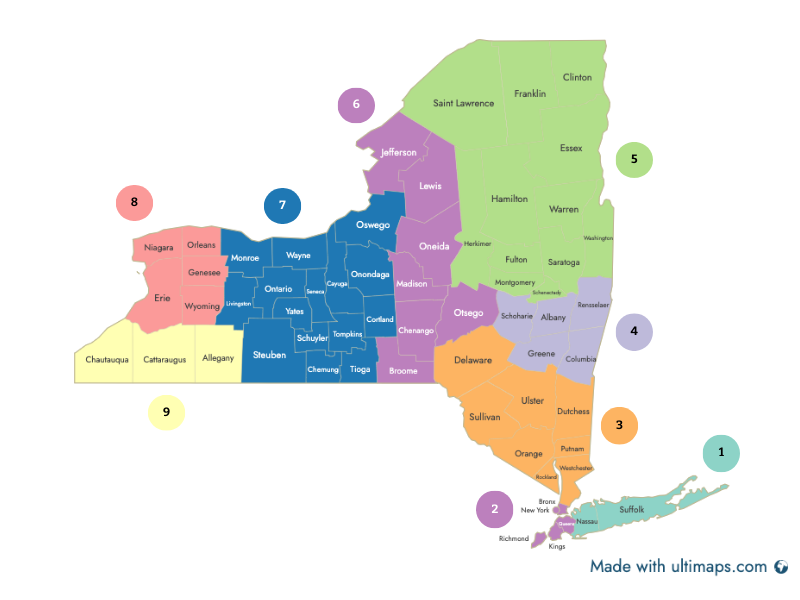
Clinical Sites by Region
- NY Region 1 (Long Island): 300+ sites
- NY Region 2 (New York City): 120+ sites
- NY Region 3 (Hudson Valley/Westchester): 50+ sites
- NY Region 4 (Catskills/Albany): 60+ sites
- NY Region 5 (Adirondacks/Saratoga): 20+ sites
- NY Region 6 (Central New York/Thousand Islands): 10+ sites
- NY Region 7 (Chautauqua/Allegheny): 4 sites
- NY Region 8 (Finger Lakes): 15+ sites
- NY Region 9 (Greater Niagara): 10+ sites
- New Jersey: 10+ sites
- Connecticut: 4 sites
